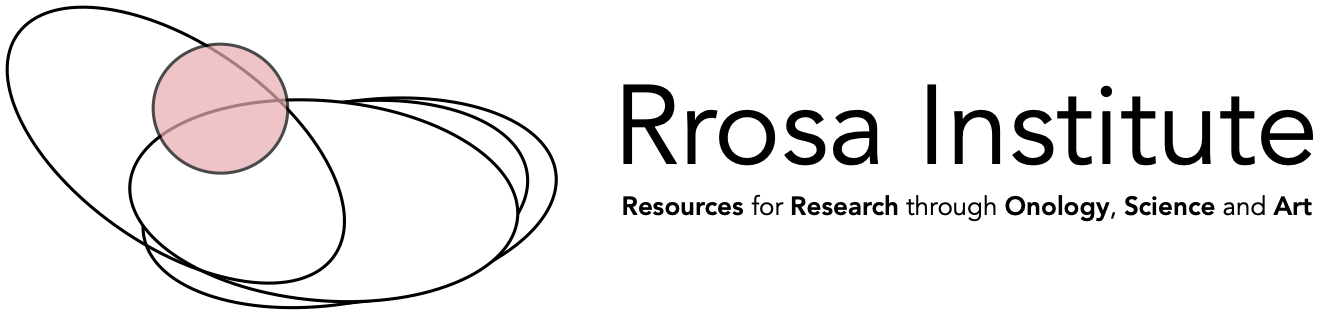
The Rrosa Institute acronym
and logo stand for Resources for Research through Onology, Science and Art
which is graphically represented by the four overlapping oval forms with the ‘rosa (Rrosa’s) space’ as their centre, which can however also be read as ripples flowing outwards from this island-based centre.
As the acronym implies, the centre strives to bring together different fields with the goal of trans-disciplinary exchanges, through conferences at the Rrosa Institute in Palermo, and to foster follow-up research when such exchanges unearth promising topics that participants are willing to pursue.
The institute’s name Rrosa also refers to Marcel Duchamp’s pseudonym ‘Rrose Sélavy’, to some of the founders’ ancestors’ family names, but also to material aspects found, by coincidence, at the nearby seashore. It is definitely not related to, for example, Edith Piaf’s ‘La vie en rose’, but rather points to an embodied material, artistic, intellectual or symbolic quality, be it historical or contemporary.
The colour ‘rose’ itself also contains elements that resonate with the Rrosa concept: Björn Vedder, in his book ‘Rosa, vom Zauber einer Farbe’, refers to the French artist Yves Klein and his ‘monochrome paintings in blue, claiming that ‘[f]ür ihn sind Rosa und Blau eigentlich dieselbe Farbe, weil sie komplementäre Bewegungen zwischen Geist und Materie symbolisieren - Blau die Vergeistigung der Materie, Rosa die Materialisation des Geistes’*, [for him, pink and blue are essentially the same colour because they symbolize complementary movements between mind and matter – blue the spiritualization of matter, pink the materialization of mind.] (2025, p. 29). Vedder’s definition seems on the one hand, to touch upon a material, symbolic quality and on the other hand, points to a complexity and trans-disciplinarity that can incorporate various levels of perception.
*Vedder, Björn (2025) Rosa, vom Zauber einer Farbe, Harper Collins, Hamburg